Anyone who has led a global sales team knows this exact math, and anyone who hasn't will eventually learn it the hard way, usually through the resignation of a good rep who got tired of being the one who always dialed in at midnight.
Read More
Through our blog posts, we are looking to share not only the value that interim and fractional sales leaders bring to an organization. We also cover a variety of topics and share our experiences, all of which are part of the “day-in-a-life” of a sales professional.
Sign up to receive updates.
Anyone who has led a global sales team knows this exact math, and anyone who hasn't will eventually learn it the hard way, usually through the resignation of a good rep who got tired of being the one who always dialed in at midnight.
Read MoreMy career has taken me to more than fifty countries at this point, and the pattern is remarkably consistent: companies treat market entry as a headcount decision when it is actually a hypothesis that hasn't been tested yet.
Read MoreThis happens more often than fractional sales leadership advocates like to admit. A CEO commits to the fractional model in principle, runs a disciplined process, finds the right person — and then a full-time résumé lands on the desk and resets the entire decision to a coin flip.
Read MoreThe pricing essays on this blog have argued, repeatedly, that pricing yourself is the hardest conversation in this work. They are right. But the difficulty is partly that we keep treating pricing as a single number rather than a small, structured menu.
Read MoreA founder once asked me, over a long lunch, whether she should hire a fractional CRO, hire a full-time VP of Sales, retain a sales consultant on a project basis, or sign with the agency her board had been recommending.
Read MoreThat is not how most fractional engagements end. A more common pattern is the slow fade — fewer meetings, more autonomy for the team, a renewal conversation that drifts past its date, and eventually a polite email about wrapping up.
Read MoreThere's a moment in every deal that almost no one designs. The contract is signed, the sales team rings the bell, and the customer — who has just spent real money on a promise — is quietly passed to whoever happens to handle “onboarding.” That handoff is where loyalty is won or lost, and most companies treat it as an afterthought.
Read MorePrivate equity firms have stopped debating whether fractional executives belong in their portfolio companies. It is standard practice now. Venture-backed founders, by contrast, still treat the same decision as a step down.
Read MoreAI engine are, without exaggeration, one of the most remarkable tools I have worked with in my career. But I am concerned that AI is making us dumber.
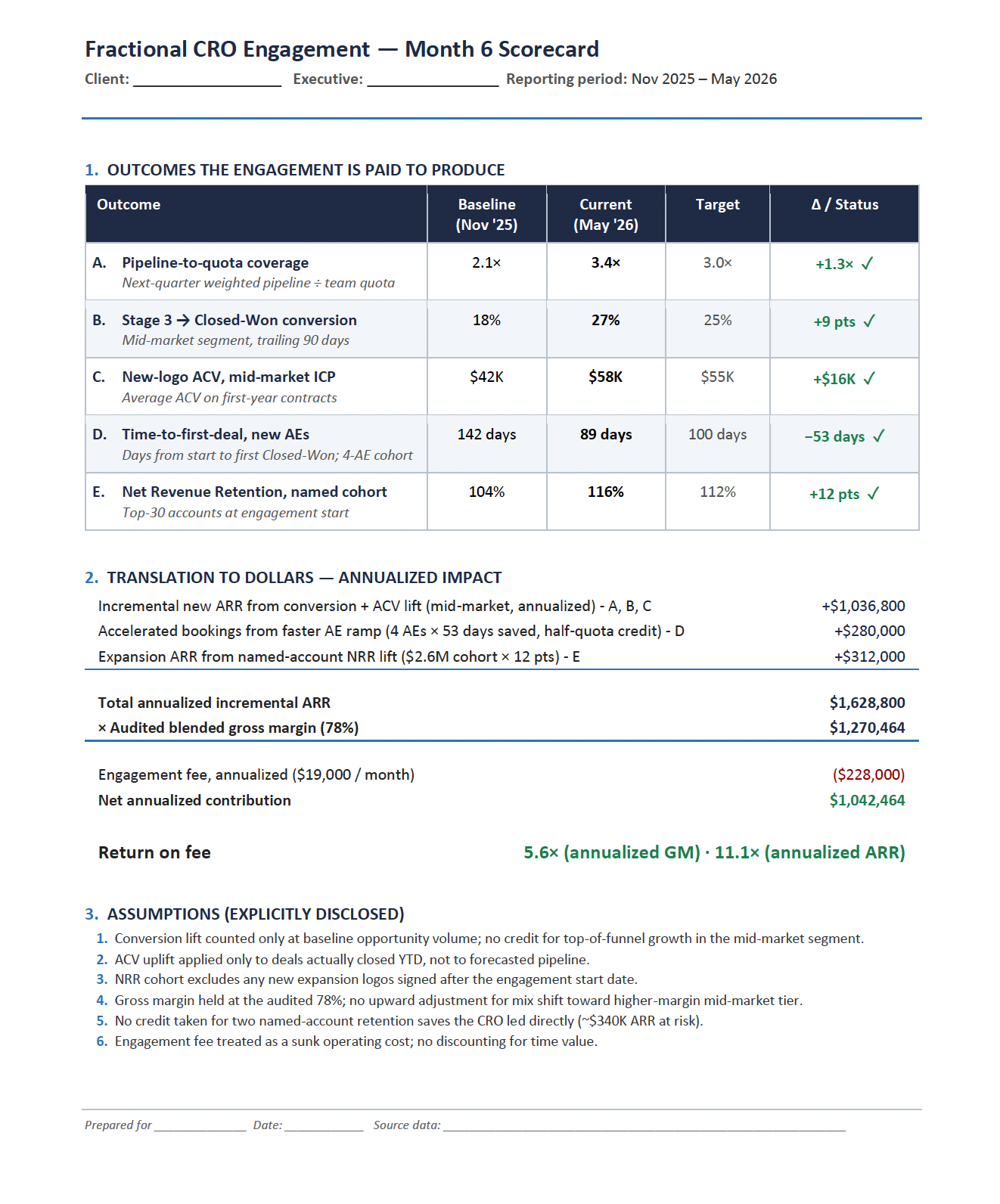
Read MoreHe liked working with the executive. His team liked working with her. The pipeline had grown. The conversion rate had improved. The forecast was more honest than it had been when she started. What was on the page was a monthly retainer that. He asked, politely, what he was paying for.
Read More